Home › Services › Siding Section Repair, Trim and Fascia
Hardboard on a 1970s to 1990s house rots from the bottom edge up, worst on the shaded rear and side walls. The repair-first rule applies: cut out and replace the failed section, and leave the sound boards alone. Whole elevations are for when the inspection says so.
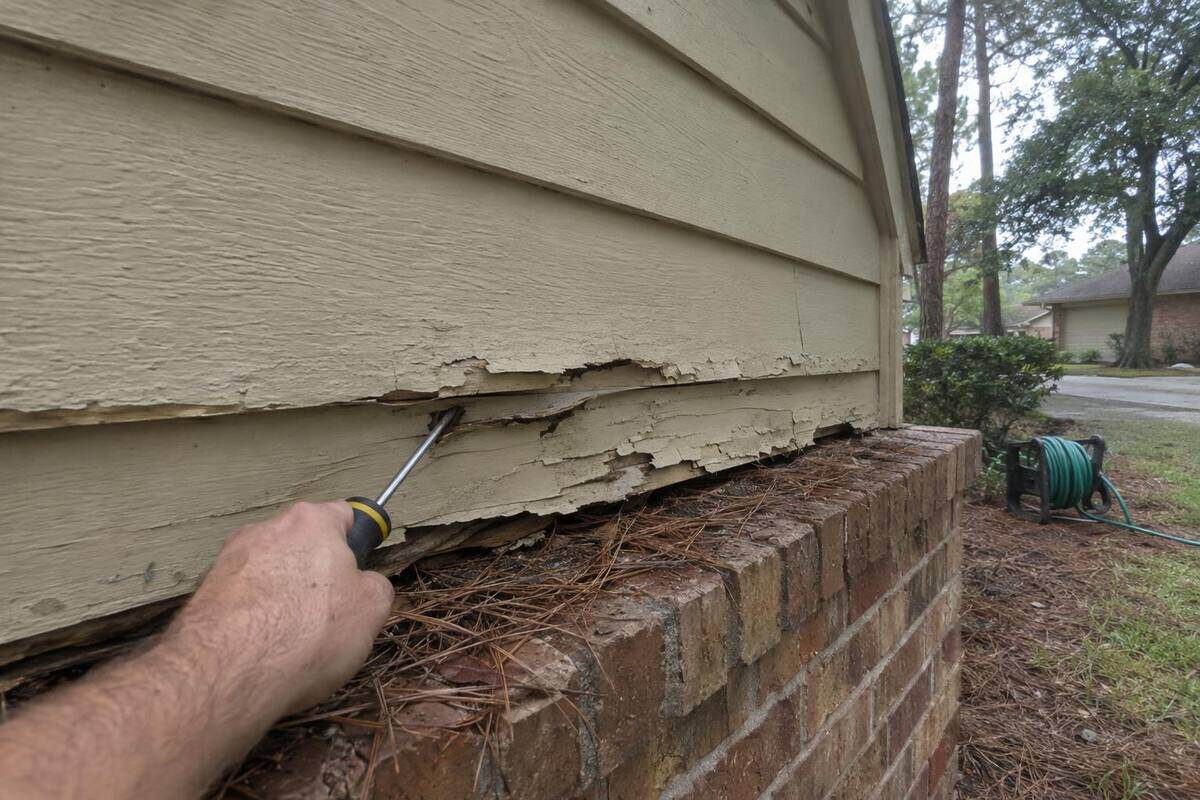
Hardboard absorbs water at its cut edges. The bottom lap of a gable under a pine, the courses behind a shrub bed, the boards nearest a sprinkler head, and the trim where a roof slope dies into a wall: those go first. Under a canopy the wall never dries out, so a north-facing gable in Spring Creek Oaks can be crumbling while the sunny front of the same house is fine. The signs are a swollen bottom edge, paint that peels in sheets because the board beneath it has moved, butt joints that have opened, and a screwdriver that goes in.
The contractor removes the failed boards back to a stud, checks the sheathing and the house wrap behind them, replaces what has rotted, and installs new boards, usually fiber-cement, with the cut edges primed and the bottom edge clear of the brick ledge and the soil. Trim is replaced where it has gone, and the joint between new and old is caulked and painted. On a hardboard wall that is otherwise holding, this buys years. It is not a way of avoiding the elevation replacement forever; it is a way of not paying for one before it is due.
The most common trim repair in Spring follows the most common gutter problem: a gutter full of needles overflows at the back, behind the fascia board, and hardboard fascia does not forgive that. The rot shows as a sag in the gutter line and a soft board when pressed. The repair is new fascia, usually a rot-resistant material, the drip edge reset over it, and the gutter rehung, ideally alongside a cleanout so it does not happen again the following fall. A limb strike at the eave produces the same repair with a different cause.
Back to the nearest studs on either side of the rot, and up to the first sound course. A typical shaded-gable repair is a few boards; a bad corner can be a dozen.
Fiber-cement lap in a similar exposure paints to match. The profile is not identical up close; from the yard it reads as one wall.
When every butt joint on an elevation has opened and the bottom laps are soft along the whole run. At that point the sound board between repairs is the minority, and the elevation is due.
Say which wall and what is over it. The contractor tells you whether it is a section or the elevation.
Call (832) 447-6614 Ask for a Verdict Spring Roofing