Home › Under the Trees
The subdivisions between FM 1960 and Spring Cypress were carved out of pine and oak woods, and the trees left standing are now the tallest thing on the street. That is why people moved here. It is also why the roofs fail the way they do.
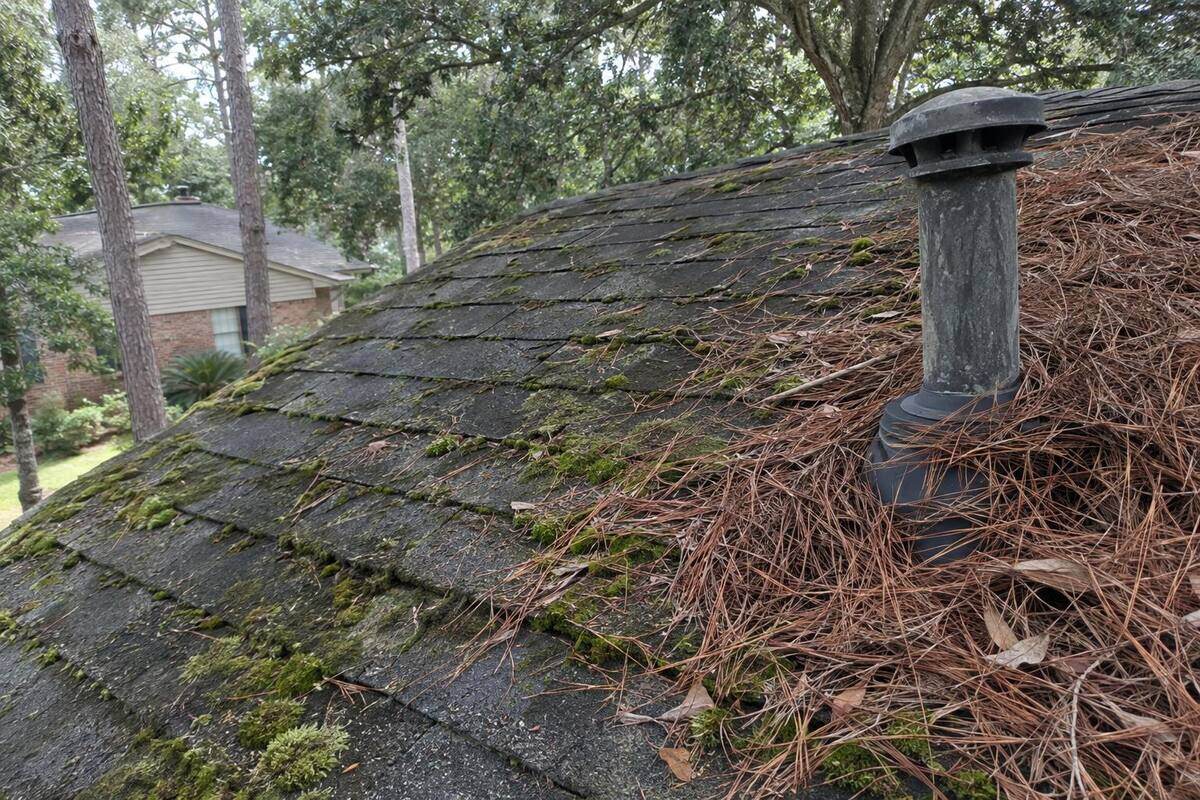
A loblolly pine sheds year-round, heaviest in fall, and every needle that lands on a roof works its way downhill into a valley. Packed needles hold water against the shingles like a sponge, and in a heavy rain they dam it. Water that cannot run down the valley runs sideways, under the shingle edge, onto the underlayment, and eventually onto the decking. On a 1980s Klein house the valley is usually the first place a roofer finds soft wood. The fix, when it is caught early, is a valley cleanout and repair; caught late, it is new decking along the valley line.
The same needles fill gutters faster than most guards can cope with. A gutter that is full to the brim overflows at the back, behind the fascia, and hardboard fascia does not forgive that for long. Gutter repair and cleanout is a standing category here for that reason, not a seasonal add-on.
Shade keeps a roof cool, which sounds like a good thing in a Houston August, and it is. It also keeps the north slope damp for days after rain, and damp shingles under a canopy grow moss and algae. Moss lifts the shingle edge as it thickens, holds water against the mat, and hides granule loss until the roofer scrapes it back. A shaded slope in Spring Creek Oaks can look fine from the driveway and be years further along than the sunny side of the same roof.
Clearing it is a repair-category job, but it is a chance to read the shingles underneath. If they come up clean with granules intact, the roof is fine and needs a trimming schedule. If the mat is exposed under the moss, that slope is telling you about its age.
Hurricane Beryl came through Spring on July 8, 2024 with 58 mph winds and 7.2 inches of rain, and Community Impact reported that roughly half the trees in the Houston area were damaged. That was two years ago, and the limbs it cracked have not all come down yet. Every ordinary thunderstorm since has finished a few more. A limb that lands on a roof does one of three things: it bruises the shingles and breaks the seal, it punctures through to the decking, or it takes the drip edge and the gutter with it on the way down. All three are repairs when the roof around them is sound, and the third one usually involves the fascia too.
The May 16, 2024 derecho, with gusts near 100 mph in parts of the metro, and the modest 2025 hail near Champions on August 18 are the other entries in the recent record. Note the size of that hail: about an inch, by a storm-tracking site’s compilation. Spring is not a hail market. It is a wind-and-trees market, and the sites that arrive after every hailstorm with a “free roof” pitch are working from a different map.
What this means for a verdict: a limb strike is a repair, almost always, if the roof it hit had life in it. The roofer’s first job is to say whether it did.
Hardboard siding, common on the gables, upper stories and rear elevations of 1970s through 1990s houses here, absorbs water at its cut edges. Under a canopy it never fully dries. The bottom lap of a shaded gable swells, the paint lets go, and the board crumbles from the edge upward. Sprinkler overspray finishes the job on the lowest courses. Trees also drop sap, tannin and leaf litter that stain the north and rear walls and keep them damp. Cedar trim on some of the older Champion Forest customs holds up better than hardboard but still rots at the joints where it meets a roof.
The repair-first rule holds for siding as well: cut out and replace the failed section while the rest of the elevation is sound; replace the elevation when every butt joint has gone. And whatever goes on, keep the trees trimmed back from the wall, because the shade that rotted the last siding is still there.
Say roughly what is overhead and what you are seeing. A local roofer who works these streets calls back.
Call (832) 447-6614 Ask for a Verdict Spring Roofing