Home › Services › Storm and Limb-Strike Roof Repair
Hurricane Beryl came through Spring on July 8, 2024 with 58 mph winds, and by Community Impact’s count damaged roughly half the Houston area’s trees. The limbs it weakened are still coming down two years later, in thunderstorms that would not have troubled a healthy pine. This is the most Spring-specific job on the site.
The limb bounces off. Nothing looks wrong from the ground, but the shingle is cracked at the mat and the seal strip under the tabs around it has let go. It leaks in the next wind-driven rain.
A branch end goes through the shingle and the decking. Water gets in immediately. The repair is a decking patch, new underlayment and shingles woven into the field around it.
The limb slides off the eave and takes the drip edge, a length of gutter and sometimes the fascia with it. That is a roof repair and a trim repair in one visit.
A limb strike is local. It damages the square yard it landed on, and the roof around that square yard is whatever it was the day before. On a roof with granules, sealed tabs and sound decking, the verdict is a repair, and it should be quoted as one, with photos of the damage and of the undamaged field beside it. The exception is a roof that was already failing, where the limb only made the first hole in a roof that was going to leak anyway. That has to be said plainly, and the six things on the verdict page are how it gets decided. The storm does not change the math; it only sets the date.
Wind without a limb is the other case. The May 16, 2024 derecho put gusts near 100 mph through parts of the metro, and wind that strong lifts tabs at the rakes, creases laminated shingles at the nail line and shifts ridge caps. Creased tabs lie back down and look fine until the next storm finishes them. A roofer walking the roof finds them; binoculars from the driveway do not.
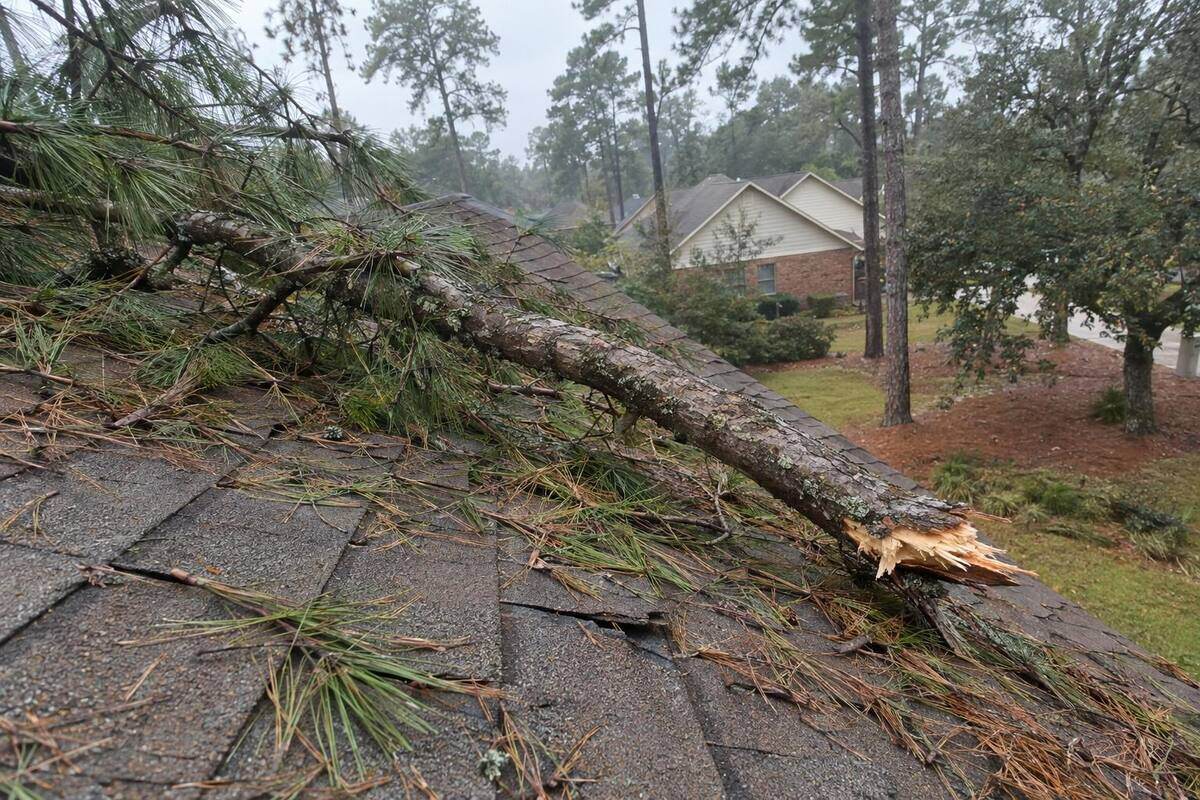
First, if water is coming in, a tarp or a temporary patch, the same day where the contractor can reach the house. Second, a walk of the whole roof, not just the spot under the limb, because a storm that dropped one branch usually dropped several and bruised more. Third, a written account with photos: what was hit, what it did, what the roof around it looks like, and a verdict. Fourth, the repair. Fifth, a word about the tree, because the limb that came down has neighbors.
Nothing here is advice about insurance, and the contractors this site introduces do not advertise around it or handle any part of an insurance matter. What a policy covers after a storm is between you, your agent and your carrier. The roofer’s job is the roof: a written verdict, photographs and a repair. What you do with that document is your decision.
Yes. Bruised shingles and broken seals are the common damage and neither shows from the ground. They leak in the next wind-driven rain.
On a roof less than about ten years old, usually yes; the shingle line is still in production and the color has not weathered far. On an older roof the patch will show a little. That is cosmetic, not a reason to replace a sound roof.
A roofer repairs the roof; an arborist deals with the tree. A limb that came down in a mild storm was probably weakened in 2024, and its neighbors may be too.
Call. A same-day cover where it is needed, then a walk of the whole roof and a written verdict.
Call (832) 447-6614 Ask for a Verdict Spring Roofing